
Blog
Equipment Appraisal in an Ohio Divorce: Dividing Farm and Business Machinery Fairly
An equipment appraisal in an Ohio divorce determines whether farm and business machinery is marital or separate property and gives the court a defensible dollar value to divide it fairly. This guide walks through Ohio's equitable distribution rules, the marital versus separate property test, and how a neutral appraisal holds up at a contested hearing.
When a farm or small business is part of an Ohio divorce, the tractors, implements, and shop equipment sitting in the barn or warehouse often carry more disputed value than the house. Ohio law requires the court to classify each piece of equipment, put a dollar figure on it, and then divide the marital estate fairly. That process depends on accurate, neutral valuation, which is where an equipment appraisal becomes part of the divorce record rather than an afterthought.
Ohio Is an Equitable Distribution State, Not Community Property
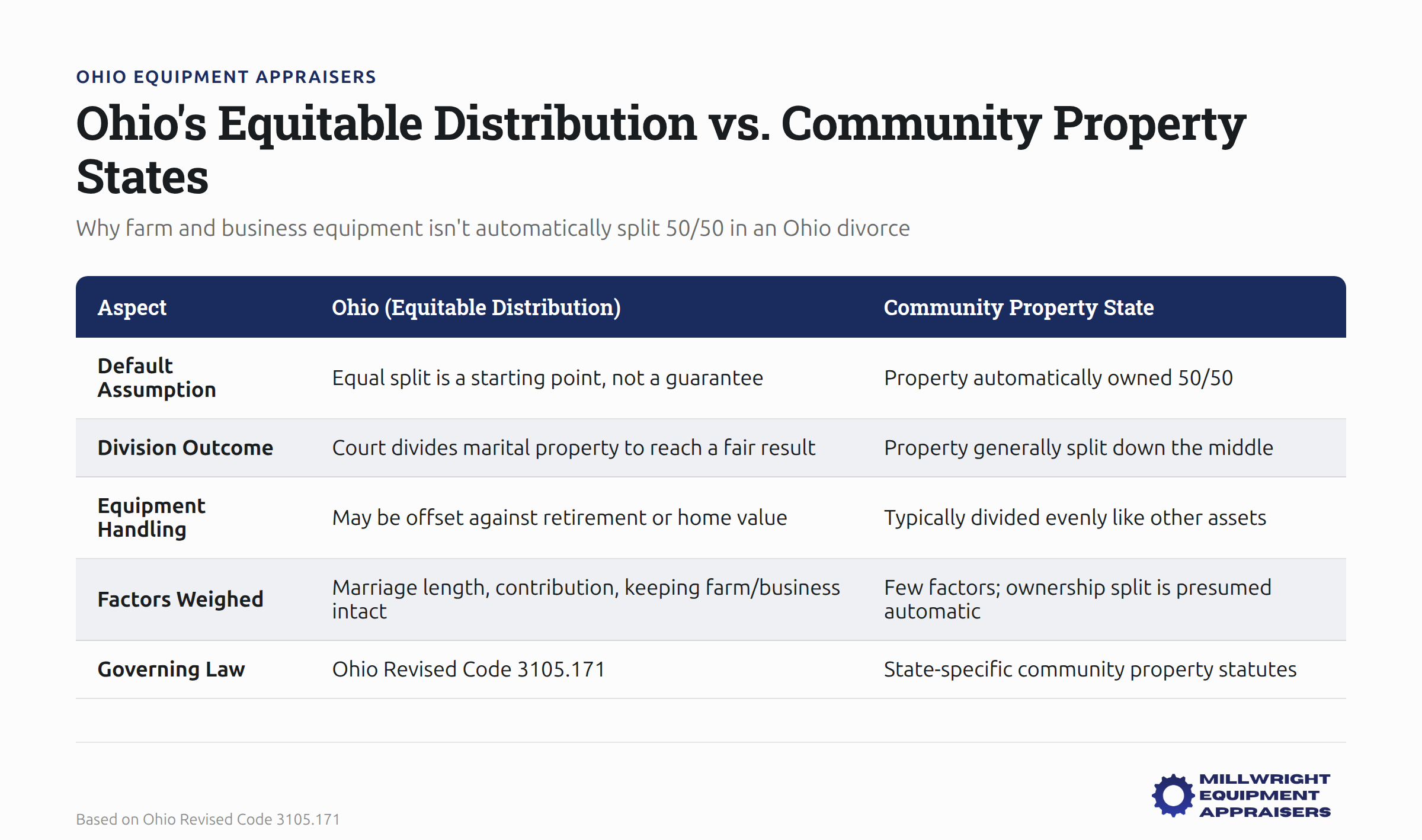
Ohio divides marital property under an equitable distribution standard, not a community property rule. That distinction matters because it changes the starting assumption a spouse can rely on.
Under Ohio Revised Code 3105.171, the court must identify all property owned by either spouse, classify it as marital or separate, assign it a value, and then divide the marital property in a manner the court finds equitable. The statute directs an equal division as a starting point, but only when equal division would actually be fair. When it would not, the court can divide the marital estate unequally to reach an equitable result.
Watch out: "Equitable" does not mean "equal." A spouse who assumes a farm's equipment will simply be split 50/50 by value is often surprised when the court instead offsets equipment against other assets, like retirement accounts or the marital home, to reach a fair overall outcome.
Equitable Distribution vs. Community Property: In a community property state, most property acquired during the marriage is automatically owned 50/50 and generally split down the middle. Ohio does not use that model. Courts here weigh factors such as the length of the marriage, each spouse's contribution to acquiring the equipment, and the economic desirability of keeping a farm or business intact as a single unit, then divide the marital estate in whatever proportion is equitable given those facts.
Marital vs Separate Property: Where Farm and Business Equipment Falls
Whether a piece of equipment gets divided at all depends on how it was acquired, not whose name is on the title. Ohio courts look past titling to the underlying facts of acquisition.
Under ORC 3105.171(A)(6)(a), separate property generally includes assets a spouse owned before the marriage, or that a spouse acquired during the marriage by gift or inheritance. Equipment purchased during the marriage with marital income, by contrast, is presumed marital property regardless of which spouse's name appears on the title or loan.
Applied to a working farm or shop, that split typically looks like this:
- Separate property: A combine a spouse owned outright before the wedding, or a tractor inherited from a parent's estate mid-marriage, generally stays with the spouse who brought it in.
- Marital property: A new baler financed and paid off with farm income earned during the marriage is part of the marital estate, even if only one spouse's name is on the equipment loan.
- Mixed cases: Equipment used for both personal and business purposes is classified by how it was acquired and financed, not by who happens to drive it.
A spouse claiming a piece of equipment is separate property bears the burden of proving that classification. Courts expect purchase records, loan documents, or estate paperwork showing the date of acquisition and the source of funds.
Commingling and Tracing: How Separate Equipment Can Lose Its Status
Inherited or premarital equipment does not automatically stay separate for the life of the marriage. If a spouse cannot trace an asset back to a separate source, courts may treat it as marital.
Ohio's guidance on farm ownership and divorce points to a common scenario: a family farm and its equipment are separate property when one spouse brought them into the marriage, but that status weakens once marital funds or marital labor go into maintaining, upgrading, or expanding the operation. If a spouse cannot document that a tractor purchased with an inheritance stayed segregated from joint farm accounts, a court may find the asset was commingled and treat it as marital.
The same principle runs in the other direction on appreciation. Ohio appellate decisions addressing property division have distinguished passive appreciation (a separate asset simply gaining value on its own) from active appreciation (value added through either spouse's labor or financial contribution), with active appreciation treated as subject to a marital claim. Example: A spouse inherits an aging tractor worth $15,000. During the marriage, the couple spends $10,000 in marital funds on a new engine and hydraulics, and the tractor is now worth $30,000. The original $15,000 may remain separate, but the $15,000 in appreciation attributable to marital investment can become a marital asset subject to division.
Valuation Timing: What Date Does the Court Use?
Ohio courts generally value marital property as of a period running from the date of marriage through the date of the final divorce hearing. That default window matters because equipment values change with age, hours of use, and market conditions.
Under ORC 3105.171(A)(2), "during the marriage" runs from the marriage date to the final hearing date unless the court finds that date inequitable, in which case it may select an alternate date, such as the date of separation. For a farm or business with equipment that continues to be bought, sold, traded in, or run down between the separation and the final hearing, that discretion can materially change which items are even in the marital pot and what they are worth by the time the court values them.
Pro tip: If equipment has been sold, traded, or heavily used between separation and the final hearing, ask the court to consider valuing the marital estate as of the separation date. Otherwise a spouse who kept working the farm equipment for another year of litigation may be penalized for depreciation the other spouse never shared.
Why a Neutral, USPAP-Compliant Appraisal Matters
A contested divorce rarely produces agreement on what a piece of machinery is worth, because each spouse has a financial incentive to argue for a number that favors their side of the ledger. A neutral third-party appraisal breaks that stalemate.
When equipment is titled to a family business or farm, both spouses and the court need a single, defensible fair market value rather than two self-serving estimates pulled from a classified ad or a rough guess. Our appraisers prepare reports in accordance with USPAP standards used across the personal property and machinery valuation fields, documenting condition, comparable sales, and methodology so the conclusion holds up if the case proceeds to a contested hearing rather than settling. Attorneys handling family business interests in Ohio divorces have noted that a credible, independent valuation is often what allows the parties to negotiate a buyout instead of forcing a forced sale of the business or its assets.
Appraisers who work in this space typically hold credentials such as ASA, ISA, CAGA, or NEBB, reflecting training specific to machinery and equipment valuation rather than general property appraisal.
How Appraisers Value Tractors, Implements, and Shop Equipment
Equipment appraisals in a divorce follow the same core methodology used for estate, insurance, or lending purposes: a defensible fair market value built from observable facts about the asset and its market. The exact approach an appraiser applies depends on the type of asset and how it will be used post-divorce.
For tractors, implements, and shop or business machinery, our equipment appraisal process generally weighs:
- Condition: Physical wear, maintenance history, and any deferred repairs that would affect what a buyer would actually pay.
- Make, model, and age or hours: Two tractors of the same model year can carry very different values depending on recorded hours of use and whether they carry attachments or upgrades.
- Market comparables: Recent sales of similar equipment, drawn from dealer listings and auction results, anchor the appraised value to what the market is actually paying rather than a book estimate.
- Replacement cost, when relevant: For newer or specialized equipment, a depreciated replacement cost approach can supplement market comparables, particularly when comparable sales are scarce.
Because a divorce fee is quoted as a fixed fee after scoping the assignment, the cost of an appraisal depends on the number of pieces of equipment involved, the completeness of purchase and maintenance records, and whether the report needs to meet the higher documentation standard of a contested hearing. Engagements are quoted before work begins and are never billed by the hour.
Worked Example: Splitting a Family Farm's Equipment
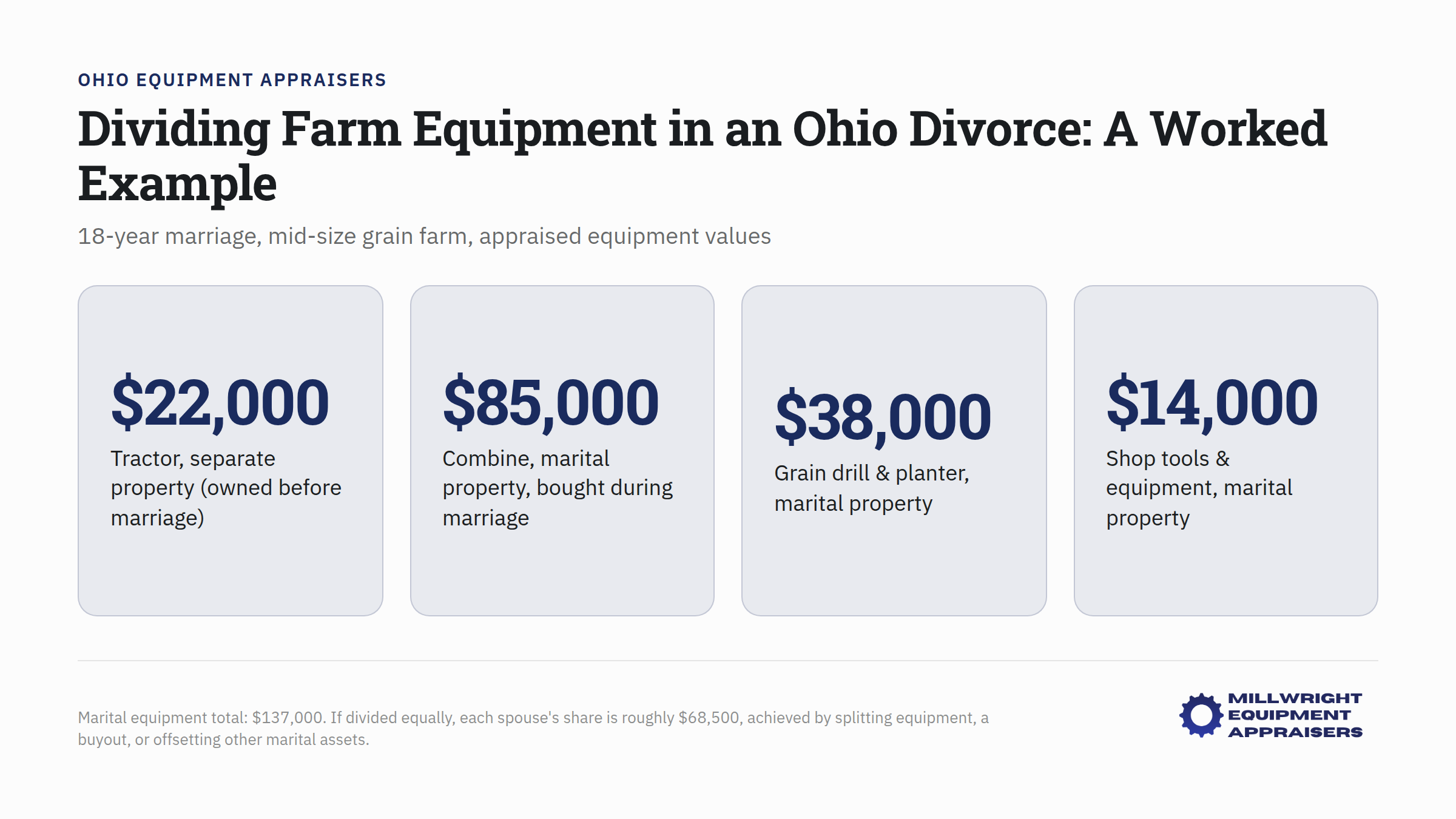
Consider a hypothetical Ohio couple, married for 18 years, who operate a mid-size grain farm together. The wife brought a tractor into the marriage; the couple purchased everything else during the marriage with farm income.
| Equipment | Acquired | Classification | Appraised Value |
|---|---|---|---|
| Tractor (owned before marriage) | Pre-marriage | Separate | $22,000 |
| Combine | Purchased during marriage | Marital | $85,000 |
| Grain drill and planter | Purchased during marriage | Marital | $38,000 |
| Shop tools and equipment | Purchased during marriage | Marital | $14,000 |
In this example, the pre-marriage tractor stays with the wife as separate property and is not part of the division. The remaining $137,000 in marital equipment is added to the rest of the marital estate. If the court determines an equal division is equitable here, each spouse's share of the equipment value would be roughly $68,500, which the parties can reach either by physically splitting equipment of comparable value, by one spouse buying out the other's interest in kind, or by offsetting the equipment against other marital assets such as bank accounts or retirement funds.
Key takeaway: The appraisal does not decide who keeps the tractor. It gives the court, and the spouses, an agreed-upon number to divide, offset, or negotiate around, which is usually what turns a contested hearing into a settlement.
Getting an Equipment Appraisal Started
Farm and business equipment often represents the single largest disputed asset category in an Ohio divorce outside real estate. A documented, USPAP-compliant valuation, prepared before positions harden, gives both spouses' attorneys a shared number to negotiate around instead of two competing guesses. Our team prepares these reports for equitable distribution matters across Ohio, working from records, photographs, and market data to reach a fair market value that can stand up if the case goes before a judge.
This article is provided for general informational purposes only and does not constitute legal, tax, or financial advice. Readers should consult a qualified attorney regarding their specific circumstances.