
Blog
Fair Market Value vs Liquidation Value for Equipment: Which Standard Ohio Appraisals Need
Fair market value, orderly liquidation value, forced liquidation value, and insurable replacement cost value all produce different numbers for the same machine. This guide explains what each standard means and which one fits your Ohio lending, bankruptcy, estate, or insurance situation.
Ask an appraiser what a piece of equipment is worth, and the honest answer starts with another question: worth to whom, and under what circumstances? A forklift can carry four different dollar figures depending on whether it's being sold at auction next week, financed at a bank, listed on an insurance schedule, or divided in a divorce settlement. Choosing the wrong standard of value doesn't just produce a report that looks off; it produces a report that fails its intended purpose. This guide breaks down the four standards our appraisers apply most often on Ohio equipment engagements and explains which one fits which situation. If you're trying to price equipment yourself before an appraisal, our guide to finding the market value of equipment is a useful starting point.
What Are the Four Standards of Value in Equipment Appraisal?
Most equipment appraisals rely on one of four defined standards of value: fair market value, orderly liquidation value, forced liquidation value, or insurable replacement cost value. Each one answers a different question about the same asset, and each is tied to a different intended use, whether that's a tax filing, a loan, a bankruptcy proceeding, or an insurance policy.
The standard isn't a stylistic choice the appraiser makes on a whim. It's dictated by why the appraisal exists in the first place. An appraiser preparing a report for an SBA-backed loan and an appraiser preparing a report for an estate tax filing on the exact same tractor will, correctly, arrive at two different numbers, because they're answering two different questions.
Fair Market Value: The Baseline Standard
Fair market value is the price a piece of equipment would bring between a willing buyer and a willing seller, neither one under pressure to act, both reasonably informed, in an open market with normal exposure time. It's the standard most people picture when they hear the word "appraisal," and it's the default premise for tax, estate, and legal work.
The definition traces directly to federal tax law. The Treasury regulation governing charitable contribution deductions states it plainly:
"The fair market value is the price at which the property would change hands between a willing buyer and a willing seller, neither being under any compulsion to buy or sell and both having reasonable knowledge of relevant facts." - Treasury Regulation 1.170A-1(c)(2)
The Uniform Standards of Professional Appraisal Practice (USPAP), published by The Appraisal Foundation, uses a nearly identical construction for its own market value definition, and professional appraisal organizations such as the American Society of Appraisers publish this same premise in their standard definitions of value used across the machinery and equipment discipline.
Fair market value assumes nobody is in a hurry. No looming deadline, no forced sale, no lender calling in a note. That's exactly why it produces the highest of the four values in most circumstances: it reflects what the equipment is genuinely worth to a normal buyer under normal conditions, not what it would fetch under distress.
Pro tip: If you're not sure which standard your situation calls for, start with the document that's requiring the appraisal (a court order, a lender's letter, a tax form) rather than guessing. The intended use dictates the standard, not the other way around.
Orderly Liquidation Value: What Lenders and Courts Rely On
Orderly liquidation value is the expected gross proceeds from selling equipment through a professionally managed sale within a reasonable but defined marketing window, with the seller compelled to sell on an as-is, where-is basis. It sits below fair market value because a compelled seller can't wait indefinitely for the ideal buyer, but it sits above forced liquidation value because there's still time to advertise and run an orderly process.
This is the standard banks and asset-based lenders lean on most often. Asset-based lending guidance describes orderly liquidation value as the figure lenders use to set collateral bases and advance rates, typically assuming a marketing period of 90 to 180 days to locate a buyer, based on industry guidance on equipment appraisals for asset-based lending. SBA-backed loans and other secured financing arrangements commonly request orderly liquidation value for the same reason: a lender needs to know what the collateral would realistically bring if the borrower defaulted and the equipment had to be sold, not what it would bring under ideal, unhurried conditions.
Orderly liquidation value also shows up in Ohio commercial finance disputes involving secured collateral. Ohio's version of UCC Article 9 requires that disposition of collateral be conducted in a "commercially reasonable" manner, but the statute itself does not mandate a specific valuation standard. In practice, orderly liquidation value is commonly used as supporting evidence of what a commercially reasonable sale would have produced, but it's industry and lending practice driving that choice, not a statutory requirement.
Forced Liquidation Value: When Time Runs Out
Forced liquidation value is the price equipment would bring in an immediate, compressed sale with minimal marketing time, most often through auction. This is the lowest of the four standards, because the compulsion to sell is paired with almost no window to find the right buyer.
A business closure that needs cash in hand within days, a lender repossession that has to move quickly, or a court order requiring disposition within a fixed short deadline (a 10-day sale window, for example) are the situations that call for this standard. Bankruptcy trustees and receivers sometimes need forced liquidation figures when a case requires an immediate sale rather than an orderly wind-down.
In Chapter 11 proceedings in Ohio's Southern or Northern District bankruptcy courts, no single valuation standard is mandated by statute. Courts weigh whatever valuation evidence is presented, and different parties in the same case may submit fair market value, orderly liquidation value, or forced liquidation value depending on what they're trying to establish, such as a secured creditor's collateral position versus a debtor's reorganization value.
Watch out: Auction results are sometimes mistaken as automatic proof of forced liquidation value. A well-advertised, well-attended auction for desirable equipment can actually land close to fair market value. The circumstances of the specific sale matter more than the sale method alone.
Insurable Replacement Cost Value: Built for Insurance Scheduling
Insurable replacement cost value is the cost to replace equipment with new property of like kind and quality, without deducting for depreciation. It isn't a sale premise at all; it doesn't ask what a buyer would pay for the existing asset, it asks what it would cost to put a comparable new asset in its place.
This distinction matters because it's the only one of the four standards that isn't tied to a hypothetical transaction between a buyer and a seller. Insurance carriers and policyholders use it to set scheduled coverage limits, since the point of the policy is to make the insured whole by funding a genuine replacement, not to estimate resale value. A 15-year-old CNC machine might have a modest fair market value but a much higher insurable replacement cost, because replacing it new costs far more than what a buyer would pay for the used unit today.
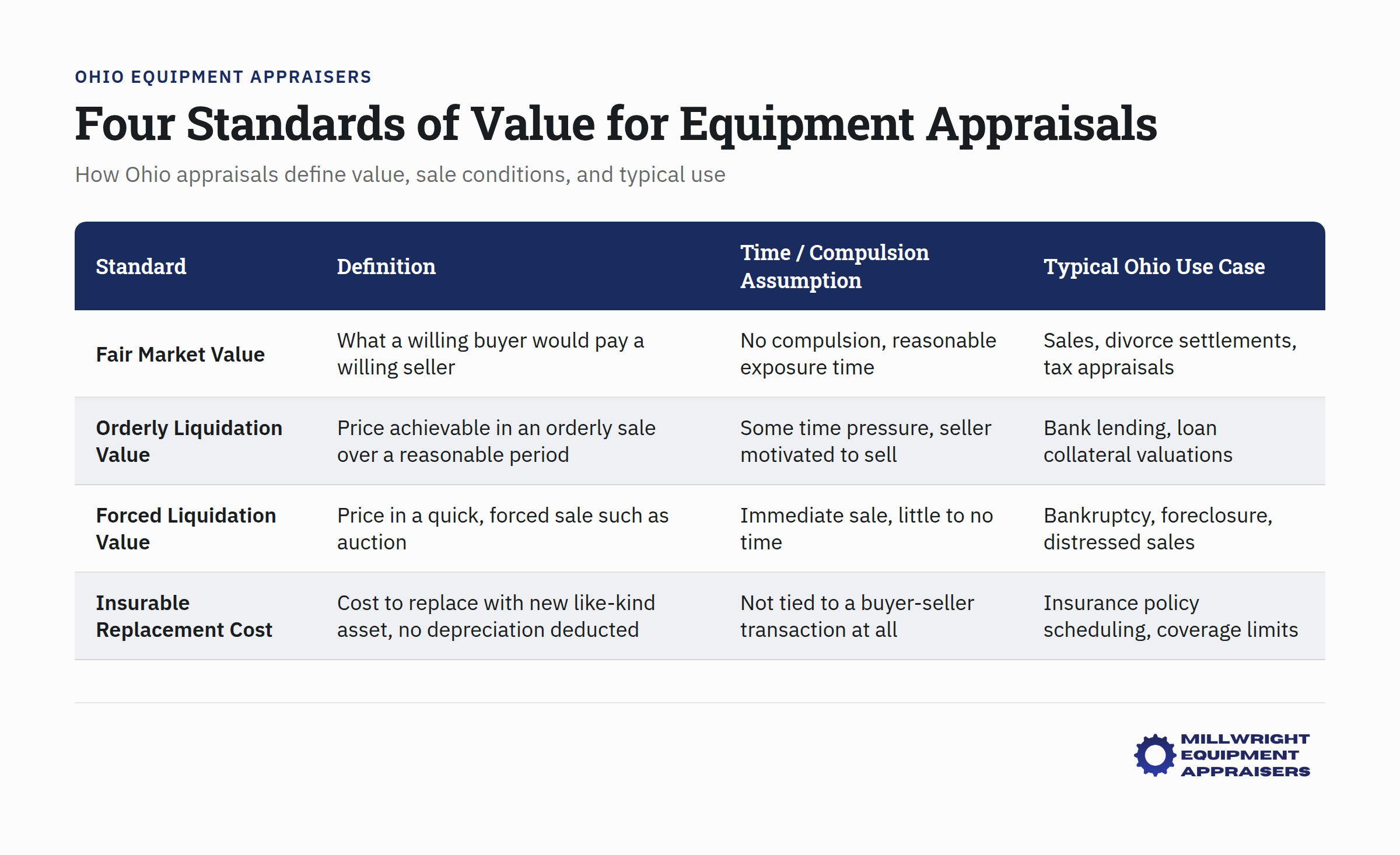
Comparing the Four Standards of Value
The table below lays out how the four standards differ in definition, in their assumption about time and compulsion, and in the Ohio situations where each one typically applies.
| Standard of Value | Definition | Compulsion / Time Assumption | Typical Ohio Use Case |
|---|---|---|---|
| Fair Market Value | Price between a willing buyer and willing seller, neither compelled, both reasonably informed, normal market exposure | No compulsion; normal marketing period | Estate and gift tax filings, divorce equitable distribution, business sales |
| Orderly Liquidation Value | Expected gross proceeds from a professionally managed sale within a defined, reasonable marketing period, as-is where-is | Seller compelled to sell; moderate time, often 90-180 days | SBA-backed and bank asset-based lending, collateral sizing, UCC Article 9 disposition evidence |
| Forced Liquidation Value | Price obtainable in an immediate, compressed sale with minimal marketing, often auction | Seller compelled to sell; very short, compressed time (days to weeks) | Court-ordered sales with fixed short deadlines, urgent repossessions, business closures |
| Insurable Replacement Cost Value | Cost to replace equipment with new property of like kind and quality, no depreciation deducted | Not a sale premise; reflects replacement cost, not a transaction price | Insurance scheduling and coverage limits |
Which Standard Applies to Your Ohio Equipment Situation?
The right standard depends entirely on why the appraisal exists, not on the equipment itself. A few common Ohio scenarios illustrate how this plays out in practice.
- Bank and SBA lending: Lenders financing equipment purchases or extending asset-based credit lines typically request orderly liquidation value, since it reflects what the collateral would realistically bring if the loan went into default.
- UCC Article 9 collateral disposition: Ohio's secured transactions law requires a commercially reasonable sale but doesn't name a required valuation standard; orderly liquidation value is commonly presented as evidence of what that commercially reasonable outcome should look like.
- Chapter 11 bankruptcy in Ohio's federal districts: Courts in the Southern and Northern Districts of Ohio weigh whatever valuation evidence parties submit; there's no statutory mandate for a single standard, so fair market value, orderly liquidation value, and forced liquidation value can each appear depending on the issue being argued.
- Estate settlement, tax filings, and divorce: These matters generally call for fair market value, since the goal is establishing what the equipment is genuinely worth to an informed, unhurried buyer. Our guide to how Ohio probate courts value farm and shop equipment walks through how this plays out in estate settlement specifically.
- Insurance coverage and claims: Scheduling equipment for a property insurance policy calls for insurable replacement cost value, since the point of coverage is funding a genuine replacement rather than estimating resale value.
Key takeaway: No single standard is universally "correct." The right one is whichever standard matches the document, court order, or regulation driving the appraisal request. Getting this wrong can mean a report that a lender, court, or IRS reviewer simply won't accept for its intended purpose.
Getting the Standard Right Before the Appraisal Begins
Our appraisers hold credentials with organizations including ASA, ISA, and NEBB, and every report is prepared in accordance with USPAP regardless of which standard of value it applies. The first conversation in any engagement is about intended use: what document is requesting this appraisal, and what standard does that document actually call for? Getting that answer right before the appraisal starts is what keeps the report useful once it's finished.
If you're not sure which standard your lender, court, or insurer needs, our team can walk through the requirement with you and scope the assignment accordingly. Request an appraisal to get started.
This article is provided for general informational purposes only and does not constitute legal, tax, or financial advice. Readers should consult a qualified attorney or CPA regarding their specific circumstances.