
Blog
How Ohio Probate Courts Value Farm and Shop Equipment During Estate Settlement
Ohio probate law treats tractors, combines, and shop tools as tangible personal property that must be valued at date-of-death fair market value, and an appraisal is required whenever that value isn't readily ascertainable. This guide covers the executor's duties, when equipment appraisal probate Ohio rules kick in, and how the valuation process works.
When a farmer or shop owner in Ohio dies, their tractors, combines, implements, welders, and compressors don't just sit in a barn waiting for heirs to sort things out. They become part of a legal inventory that the probate court will scrutinize, and in many cases, they need a formal appraisal before that inventory can be approved. Executors who treat this step as an afterthought risk delays, disputes among heirs, and inventories that get challenged. This guide walks through what Ohio Revised Code Chapter 2115 actually requires and how our Ohio equipment appraisal services fit into that process.
What Ohio Law Requires When Equipment Passes Through Probate
Every executor or administrator in Ohio must file an inventory of the decedent's tangible and intangible personal property, and that inventory must set values as of the date of death, not the date the estate gets around to selling anything. Under R.C. 2115.02, that filing is due within three months of the fiduciary's appointment unless the probate court grants an extension for good cause.
The same section carves out an important exception: any asset whose value is "readily ascertainable" does not require a formal appraisal, though it still has to appear on the inventory. Courts apply this most often to passenger vehicles, where blue-book pricing gives a reliable, publicly available number. Farm machinery and shop equipment usually don't have that kind of standardized retail pricing, which is exactly why they tend to require a separate, sworn appraisal rather than a guess based on a purchase receipt from a decade ago.
Executor Duties: Identifying and Inventorying Farm and Shop Equipment
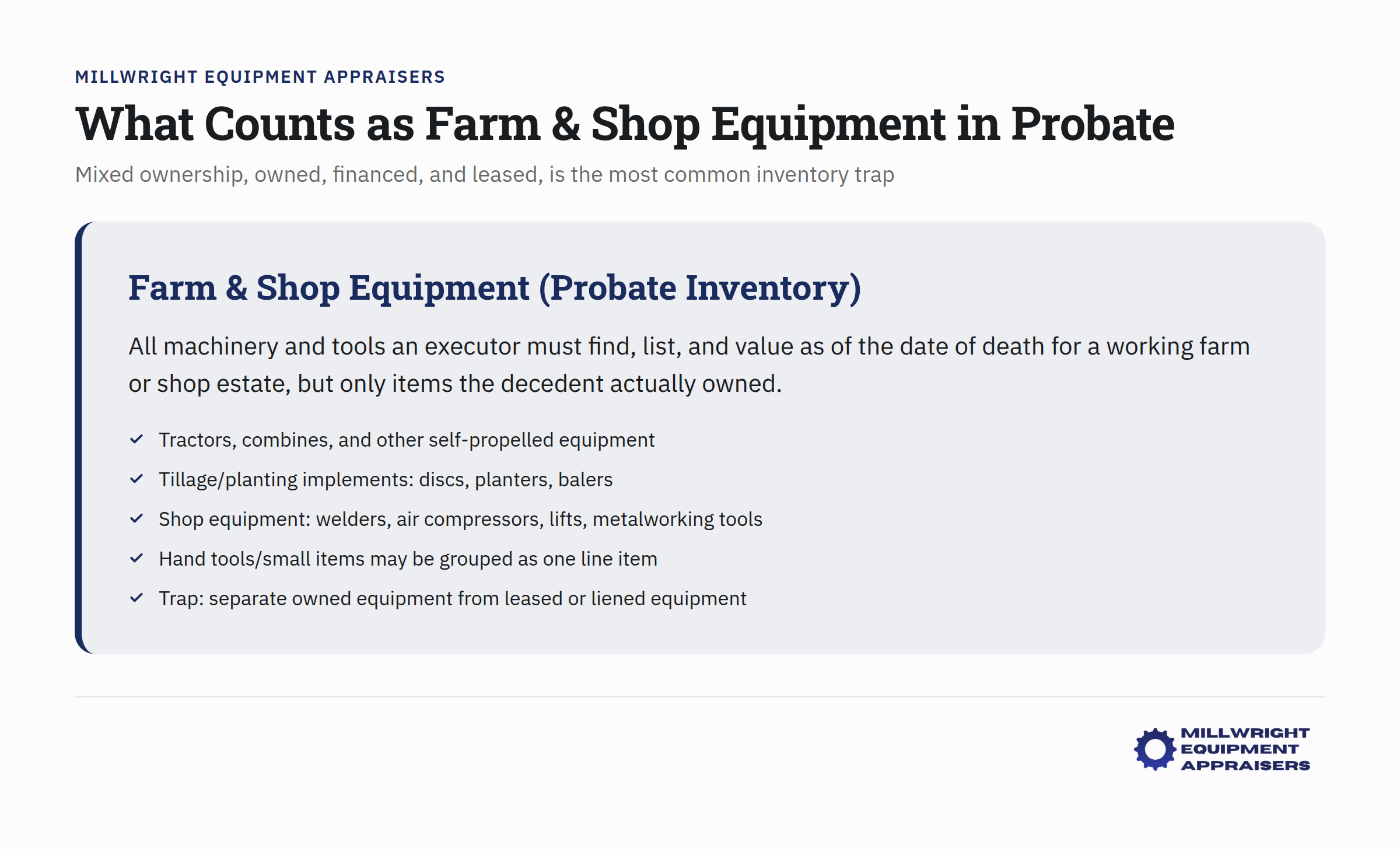
The executor's first job is simple to state and harder to execute: find everything, list everything, and value everything as of the date of death. For a working farm or shop, that inventory typically includes:
- Tractors, combines, and other self-propelled equipment
- Tillage and planting implements such as discs, planters, and balers
- Shop equipment including welders, air compressors, lifts, and metalworking tools
- Hand tools and smaller shop inventory that may be grouped as a single line item
- Any equipment held under a lease or loan arrangement, which needs to be separated from equipment the decedent actually owned
Mixed ownership is a common trap. Farm operations frequently run a combination of owned equipment, financed equipment still carrying a lien, and leased machinery that never belonged to the estate at all. An executor who lists leased equipment as an estate asset, or misses a lien that reduces the estate's actual interest, creates problems that surface later when the inventory is reviewed or challenged.
When Does Farm or Shop Equipment Need a Formal, Independent Appraisal?
A formal appraisal is warranted whenever equipment value is not readily ascertainable from a bill of sale, a title, or a standardized pricing guide. County probate courts illustrate the contrast clearly: motor vehicles can often be valued from blue-book sources without triggering a separate appraisal requirement, as Butler County's probate instructions explain, but there's no equivalent public reference table for a used combine, a 15-year-old disc harrow, or a shop full of welding and metalworking equipment.
R.C. 2115.06 requires the executor or administrator to appoint a "suitable disinterested person" to appraise property listed on the inventory, subject to the probate court's approval, unless the court dispenses with appraisal by order. In practice, a formal appraisal makes sense whenever one or more of these conditions apply:
- The equipment has no clear retail comparable and its value depends on condition, hours, and local market demand
- The total value of the farm or shop equipment is significant relative to the rest of the estate
- Heirs disagree about what the equipment is worth or how it should be divided
- Ownership is mixed between the decedent and a business entity, lease, or lender
- There's a real chance the inventory will be challenged and the executor needs a defensible, standards-compliant report to back it up
Our guide on how to find the market value of equipment walks through the data sources appraisers actually use for this kind of machinery, which is worth reading before assuming a number from an old invoice will hold up.
Watch out: Courts in Ohio have looked closely at how appraisers group and price farm assets in disputed estates. In one Seventh District Court of Appeals case, the tangible personal property appraisal split items into categories such as "Trucks, Auto, Farm Equipment" and "Shop Tools, Miscellaneous," as documented in the court's opinion, and individual item values still had to hold up under scrutiny. Grouping equipment for convenience doesn't excuse an appraiser from being able to defend each figure.
The Date-of-Death Fair Market Value Standard
Ohio probate inventories value property at fair market value as of the date of death, and that standard mirrors the federal estate tax definition: the price at which property would change hands between a willing buyer and a willing seller, with neither party under any compulsion to act and both having reasonable knowledge of the relevant facts. For farm and shop equipment, that means an appraiser has to price the machinery as it actually sat in the barn or shop on the date of death, not what it would fetch after repairs, not what it cost new, and not what a rushed liquidation sale might bring.
Example: A tractor purchased for $85,000 six years before the owner's death is not valued at its original purchase price or its insured replacement cost. It's valued at what an informed buyer would pay for that specific tractor, in its actual hours and condition, in the local equipment market on the date of death.
How the Equipment Appraisal Process Works
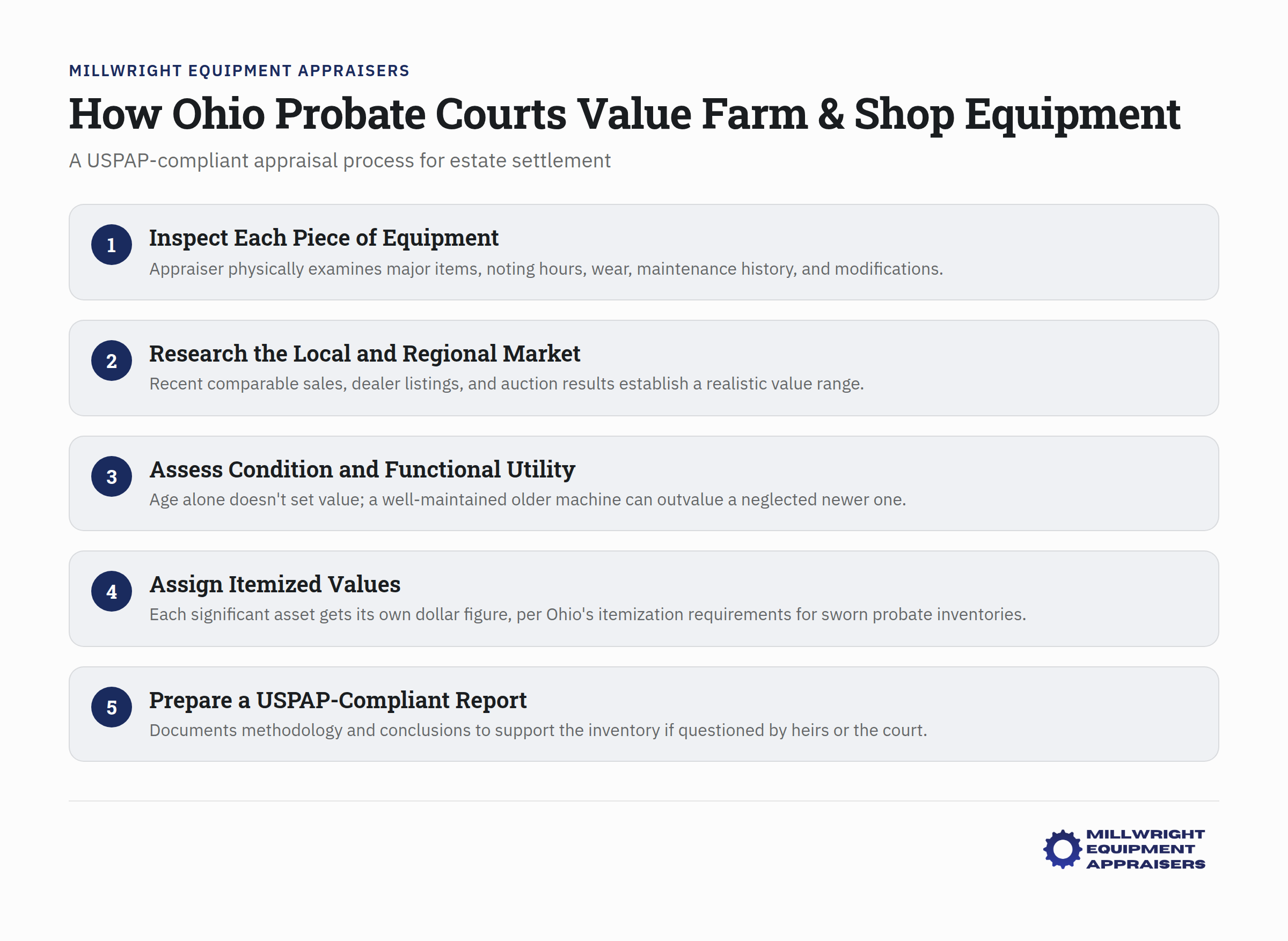
A USPAP-compliant equipment appraisal for probate purposes follows a consistent process regardless of whether the estate includes one tractor or an entire fleet:
- Inspect Each Piece of Equipment
- The appraiser physically examines major items, noting hours, wear, maintenance history, and any modifications.
- Research the Local and Regional Market
- Recent sales of comparable equipment, dealer listings, and auction results establish a realistic value range.
- Assess Condition and Functional Utility
- Age alone doesn't determine value; a well-maintained older machine can outvalue a neglected newer one.
- Assign Itemized Values
- Each significant asset gets its own dollar figure, consistent with the itemization Ohio law expects when appraisers are sworn in for probate inventories.
- Prepare a USPAP-Compliant Report
- The finished report documents methodology and conclusions so it can support the inventory if an heir or the court asks questions later.
Worked Example: Valuing a Working Farm Estate's Equipment
Consider a mid-sized Ohio grain farm where the decedent owned a combine, a tractor, a disc, and a shop full of tools. A recent appraisal for a comparable estate might look like this:
| Item | Description | Appraised Value |
|---|---|---|
| Combine | 2015 model, 1,800 engine hours, good condition | $145,000 |
| Tractor | 2012 model, 3,200 hours, routine maintenance | $62,000 |
| Disc harrow | 24-foot, moderate wear | $8,500 |
| Shop tools, welders, and compressors | Grouped as miscellaneous shop equipment | $6,200 |
| Total | $221,700 |
This total becomes part of the estate's overall inventory value, which affects everything from probate fees to how the estate is divided among heirs. An inventory this size, built on defensible per-item values rather than rough estimates, is far less likely to draw an exception from an heir or a challenge from the court.
Key takeaway: The dollar figure matters less than the documentation behind it. A $221,700 valuation supported by inspection notes and market comparables holds up. The same number pulled from memory or an old purchase receipt does not.
What an Appraisal Costs and Who Performs It
Our appraisers hold credentials with organizations such as ASA, ISA, and CAGA, and every farm equipment and shop equipment appraisal is prepared in accordance with USPAP. For farm equipment, fees for a standard scope engagement start at $295, with IRS-qualified level reporting starting at $395; most probate assignments involving several major pieces of equipment run $695 to $2,200 depending on the number of items and how much research the local market requires. A larger operation with many high-value machines can run into the $5,000 to $10,000-plus range.
Engagements are quoted as a fixed fee after we scope the assignment, never billed by the hour. For a fuller breakdown of what drives that number, see our answer to how much does an appraiser cost in Ohio.
Pro tip: Fees are driven by scope, not by how valuable the equipment turns out to be. A combine worth $145,000 doesn't cost more to appraise than a combine worth $45,000 if the inspection and research involved are similar; what changes the fee is the number of items, the completeness of the records, and whether the report needs to meet IRS-qualified standards.
Filing the Inventory and Handling Objections
Once the appraisal is complete, the executor files the inventory with the probate court. Ohio law gives interested parties, including other heirs, the chance to file exceptions to the inventory before the court's scheduled hearing on it, and the court then rules on any objections raised. This is precisely the scenario where a professionally documented, USPAP-compliant appraisal earns its cost: it gives the executor a defensible answer if a sibling or other heir questions why the combine was valued at $145,000 instead of $200,000.
Owners considering how equipment might be treated outside of probate entirely, through a business entity or a transfer arrangement, may find it useful to review general Ohio probate resources on farm estate planning alongside their attorney's guidance, since not every farm asset necessarily runs through the probate inventory process.
Getting the Inventory Right the First Time
Executors handling a farm or shop estate in Ohio don't need to guess at equipment values or hope a rough estimate survives court review. R.C. 2115.02 and R.C. 2115.06 set out when a formal appraisal is required, and a sworn, disinterested appraiser gives the estate a number that can stand up to an heir's objection or a judge's question. Getting a qualified appraisal early, before the three-month inventory deadline closes in, keeps the estate settlement moving instead of stalling over a dispute that a defensible report would have prevented.
If you're serving as executor for an estate that includes farm machinery, shop tools, or other equipment, request an appraisal to get a fixed-fee quote scoped to your inventory.
This article is provided for general informational purposes only and does not constitute legal, tax, or financial advice. Readers should consult a qualified attorney or CPA regarding their specific circumstances.