
Blog
Does Ohio Tax Business Equipment as Personal Property? What Owners Need to Know
Ohio phased out its tax on business equipment as personal property between 2006 and 2009, so most owners no longer file an annual return for machinery or inventory. This guide explains what changed, what Ohio still taxes, and when an independent equipment appraisal still matters for real property disputes and business transactions.
No. Ohio does not tax business equipment, machinery, or inventory as tangible personal property, and it hasn't since tax year 2009. The general business personal property tax was phased out over several years and now sits at a permanent 0% listing percentage. If you're a business owner in Ohio wondering why you no longer get a personal property tax bill, or why an old filing requirement seems to have disappeared, the short answer is that the requirement itself is gone. Our Ohio equipment appraisers still get this question often, usually from owners comparing old paperwork to a current real property notice that looks unfamiliar.
What hasn't gone away is the underlying confusion between what counts as real property and what counts as personal property, especially at manufacturing and industrial sites where machinery gets bolted to a building. That distinction still drives real disputes today, and it's where a defensible equipment appraisal earns its keep.
How Ohio Phased Out the Tax on Business Equipment
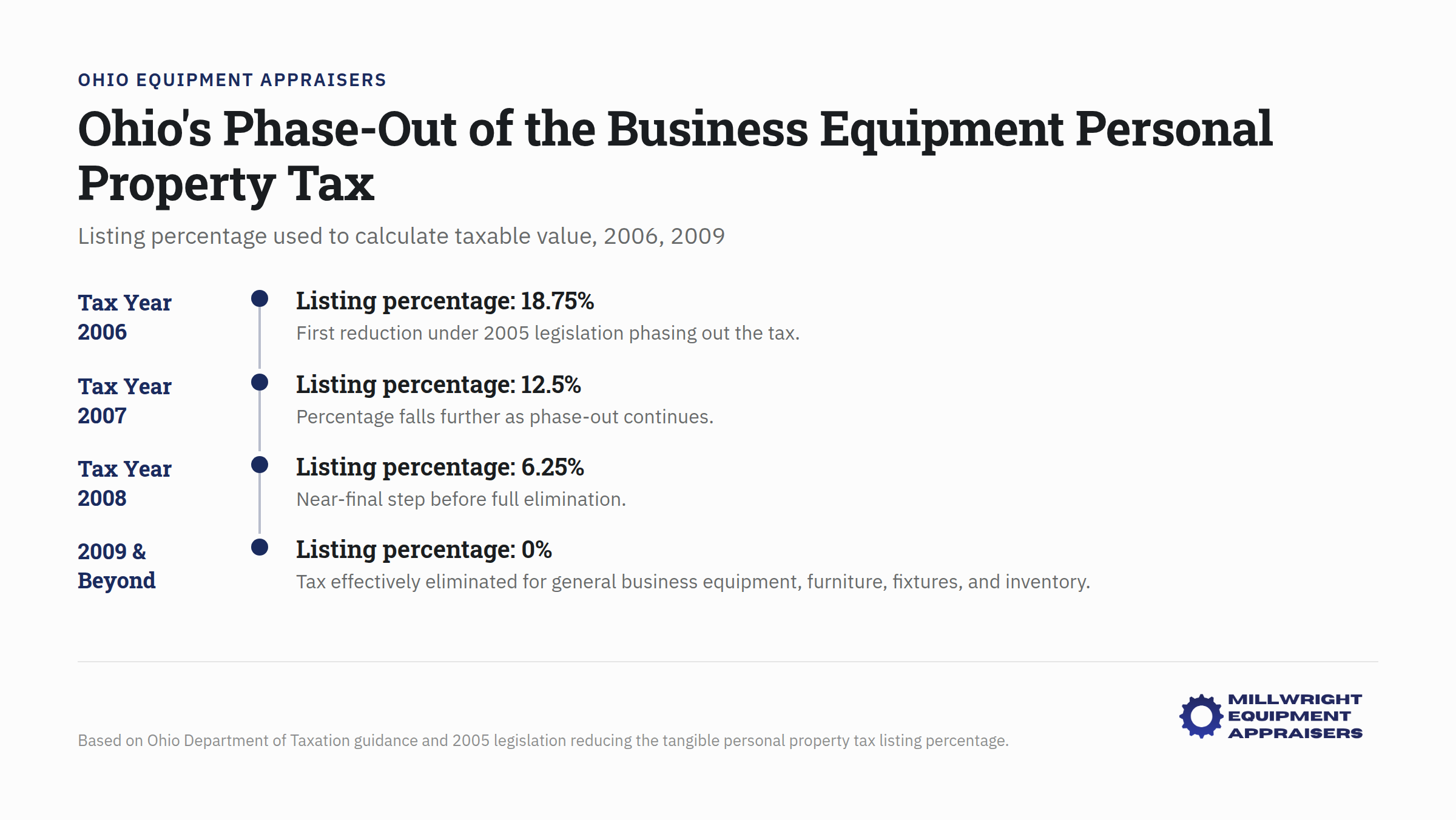
Ohio's tangible personal property tax on business equipment wound down in stages rather than disappearing overnight. Legislation passed in 2005 reduced the listing percentage used to calculate taxable value each year until it hit zero.
- Tax year 2006: the listing percentage dropped to 18.75%.
- Tax year 2007: the percentage fell further to 12.5%.
- Tax year 2008: it dropped again to 6.25%.
- Tax year 2009 and beyond: the listing percentage reached 0%, effectively eliminating the tax for general business equipment, furniture, fixtures, and inventory.
Before the phase-out, the Ohio Department of Taxation's guidance treated machinery, equipment, furniture, fixtures, small tools, supplies, and inventory used in a business as part of the taxable base, valued generally at depreciated book value. Where a taxpayer had fully depreciated equipment and no disposal records, the state used an exhaustion method to estimate remaining value, a valuation approach spelled out in Ohio's administrative code. That machinery survives today only as historical record. County auditors no longer require the old annual filings (commonly known by their form numbers) for general business equipment, and there is no active deadline to track for this tax.
What Ohio Still Taxes on Business Property Today
Ohio still taxes real property, meaning land and buildings, through the county auditor's office on the standard triennial reappraisal and annual update cycle. That tax never went away and isn't part of this discussion.
A narrow category of public utility tangible personal property, covering assets like railroad, pipeline, and certain utility infrastructure, remains taxable under special statutory rules. That category applies to a small set of regulated industries and isn't relevant to the vast majority of Ohio businesses.
It's also worth separating this from the Commercial Activity Tax (CAT), which is a gross receipts tax on business revenue, not a property tax on equipment or inventory. The CAT and the old personal property tax are unrelated mechanisms: one taxes what a business owns, the other taxes what it sells. Business owners sometimes conflate the two because both eras of Ohio tax reform happened around the same time, but they solve different problems and have different bases entirely. For a closer look at how exemptions and equipment tax questions play out in practice, see our equipment tax exemption guide for Ohio.
Key takeaway: if you're filing anything today related to equipment and Ohio taxes, it's almost certainly a real property matter, a CAT matter, or a federal tax matter, not a personal property tax return.
When Equipment Value Gets Folded Into a Real Property Assessment
Here's the live issue for manufacturing, processing, and industrial property owners. Even though Ohio no longer taxes equipment as personal property, county auditors sometimes fold the value of machinery, process piping, or specialized building systems into the real property assessment when that equipment is deemed part of the structure.
Ohio law draws a line between real property and a business fixture, a defined subset of personal property. Under Ohio Revised Code definitions, a business fixture generally includes machinery, equipment, signs, storage bins and tanks, and portions of a building specially designed for the business's operation, as distinct from ordinary structural components. The distinction matters because equipment classified as a business fixture should not be swept into the taxable value of the real property, even though it may look permanently installed.
In practice, this gets murky at working industrial sites. Heavy machinery bolted to a concrete pad, custom electrical service run for a specific process line, or specialized ventilation built for manufacturing can all get miscounted as part of the building's assessed value if nobody separates them out. A recent legal analysis of a business fixture ruling highlights just how consequential this classification question can be for a property owner's tax bill. An independent equipment appraisal gives the property owner (and, if needed, the county Board of Revision) the evidence to separate fixture value from realty value, item by item, with documented depreciation and market support behind each figure. Our guide on desktop versus onsite equipment appraisal for Ohio assignments walks through how we scope that kind of engagement depending on the size and complexity of the facility.
Watch out: Don't assume a county auditor's assessment automatically excludes process equipment just because Ohio no longer taxes equipment as personal property. If the auditor's valuation lumps machinery into the building's assessed value, the burden falls on the property owner to prove which dollars belong to which category.
Appealing an Assessment Through the Board of Revision
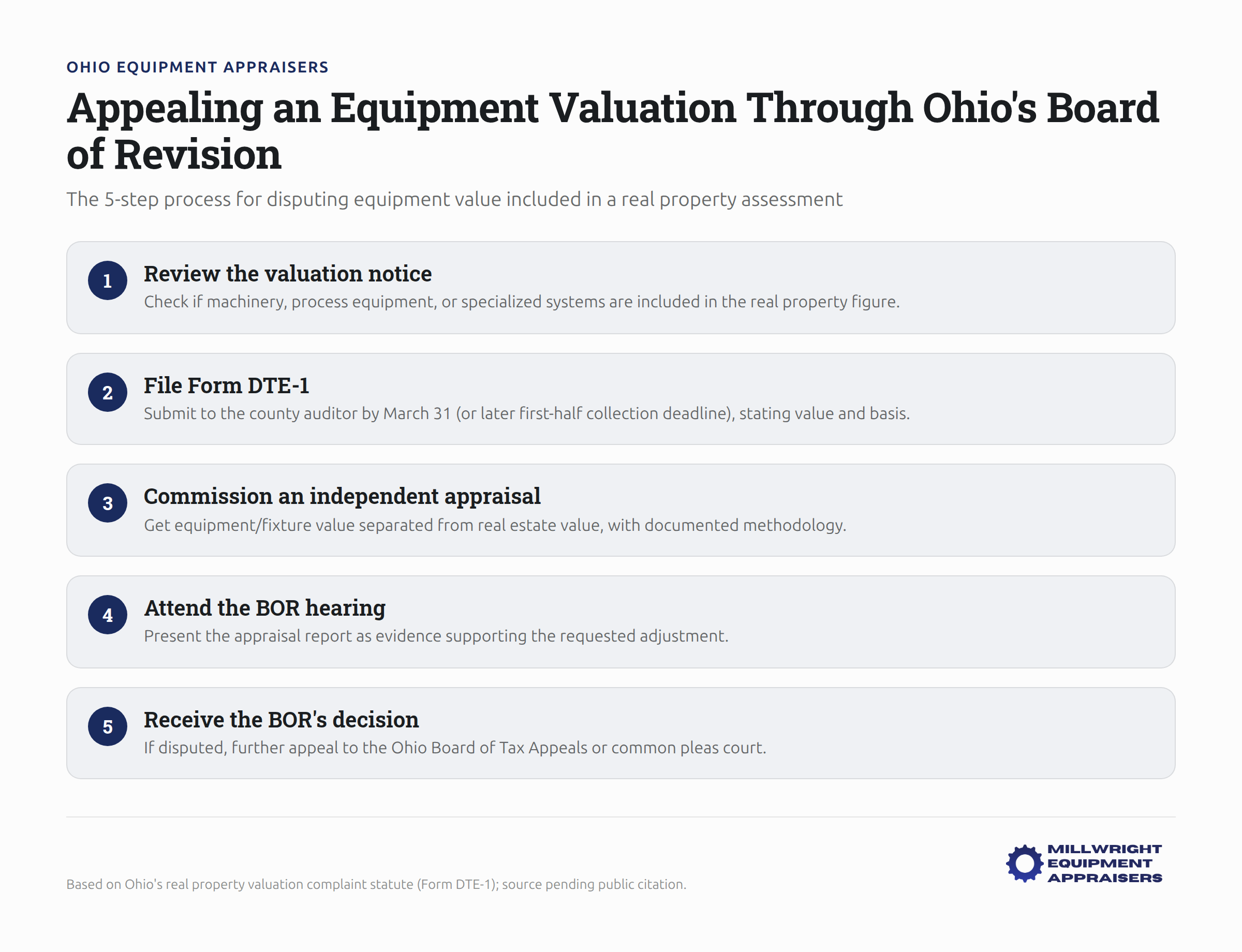
If a real property valuation appears to include equipment value it shouldn't, the correction path runs through the county's Board of Revision (BOR). Ohio property owners can file a formal complaint against the county auditor's valuation using Form DTE-1, generally due by March 31 of the year following the tax year at issue, or by the closing date of the first-half tax collection period if that date falls later. This process and its deadlines are established under Ohio's real property valuation complaint statute.
The practical sequence looks like this for most owners:
- Review the auditor's valuation notice for the tax year in question and identify whether machinery, process equipment, or specialized systems appear to be included in the real property figure.
- File Form DTE-1 with the county auditor by the statutory deadline, stating the requested value and the basis for the complaint.
- Commission an independent equipment appraisal that separates business fixture and personal property value from the real estate, supported by documented methodology.
- Attend the Board of Revision hearing, presenting the appraisal report as evidence for the requested adjustment.
- Receive the BOR's decision, which can typically be further appealed to the Ohio Board of Tax Appeals or common pleas court if the owner disagrees with the outcome.
County auditor offices, including smaller counties that still publish general personal property guidance for reference, confirm that the old annual equipment filing no longer applies to general businesses, which is exactly why the BOR process for real property, not a personal property return, is the mechanism owners actually use today when equipment valuation is in dispute.
Other Reasons Ohio Businesses Still Need Equipment Appraisals
Even without an annual tax filing to worry about, Ohio businesses have plenty of legitimate reasons to commission a machinery and equipment appraisal. The most common triggers we see include:
- Financing and collateral: lenders want a defensible, current value for machinery pledged as collateral before extending or renewing a loan.
- Sale or acquisition: buyers and sellers need an independent value opinion for equipment included in an asset purchase agreement.
- Partner buyouts and litigation: disputes among business partners or in divorce and dissolution matters often hinge on an agreed, credible equipment value.
- Insurance coverage: carriers and policyholders alike benefit from documented replacement cost or actual cash value figures before a loss occurs, not after.
- Estate, gift, and charitable donation purposes: transferring or donating business equipment can trigger IRS documentation requirements tied to the asset's fair market value.
Our machinery and equipment appraisers hold credentials with organizations such as the American Society of Appraisers (ASA) and the Certified Appraisers Guild of America (CAGA), and every report is prepared in accordance with USPAP so it holds up whether it's headed to a lender, a courtroom, or a county Board of Revision. Engagements are quoted as a fixed fee after we scope the assignment, never billed hourly. For a typical machinery and equipment appraisal, standard reports start from $295 and IRS-qualified advanced reports start from $395, with most engagements running $695 to $3,000 depending on the number of assets, record quality, and intended use; highly complex industrial portfolios can run $5,000 to $10,000 or more.
No Annual Filing, but Defensible Value Still Matters
Ohio retired its general business personal property tax more than a decade ago, and there's no annual equipment return to file, no threshold to track, and no listing percentage left to calculate. What remains is a narrower but real question: whether equipment value is being counted correctly wherever it does show up, whether that's a real property assessment that swept in machinery it shouldn't have, or a transaction, loan, dispute, or filing where an accurate, independent number carries real weight.
If you're facing a real property assessment that seems to include equipment value, or you need a defensible number for financing, a sale, or an estate matter, request an appraisal and our team will scope the engagement to your situation.
This article is provided for general informational purposes only and does not constitute legal, tax, or financial advice. Readers should consult a qualified attorney or CPA regarding their specific circumstances.